“The same candidate reaches us four ways. Past search, vendor, sourced, applied, and no two agree on how far along she is.”
Skip the resume.
Meet the candidate.
HiringScout screens the resumes, makes the calls, and runs the interviews. You get the assessment, the recording, and the transcript behind every name.
Screens, calls, and interviews, done for you.
A hiring partner that truly understands your needs
Requirement
Sourcing
Reachout
Screen
Interview
01Requirement
Tell it the role once, in whatever form you have it
- SARA writes the job from a form, a pasted brief or a conversation
- Title, must-haves, seniority and salary come back as editable fields, not prose
- Your screening bar is set here too, from knockouts to weighting to the score that passes
- SEO-compliant, posted to your careers page, LinkedIn and Indeed in one pass
02Sourcing
Candidates found and ranked before you open the pipeline
- Applications, referrals, your own LinkedIn, bulk resumes or an ATS sync
- Sourcing starts narrow and widens one constraint at a time. Four rungs, then it stops
- Every match ranked against the real job, reason attached. Past applicants re-scored too
- You see the list before anyone is contacted
03Reachout
The chasing, done properly and done for you
- Build the flow yourself with email, LinkedIn and phone, in the order you choose
- Follow-ups run on schedule and stop the second someone replies
- An AI call in the candidate's own daytime hours, from your number
- Sent from your own mailbox, with unsubscribe and suppression handled
04Screen
From a cold list to a scored conversation
- Resumes scored on nine weighted dimensions against the bar you set
- An AI phone screen with your knockouts asked first, so wrong fits end early
- Every call transcribed, summarised and attached to the candidate
- You read a shortlist with reasons, not a stack of PDFs
05Interview
A full interview, then your call
- Live coding that actually runs, plus a design board they have to defend
- Behaviour, cognition, communication and fit scored in the same session
- Proctored end to end, with an optional government-ID check before it opens
- Your own rounds carry on from there. No auto-hire, no auto-reject
I am a
Struggling to place faster
than your competition?
“We re-screen people we already screened. Nobody can tell it is the same person until the interview.”
“Margin dies in the middle. Recruiter hours per placement is the number that decides whether a req was worth taking.”
Four origins merge on name, email, phone and work history the moment the second record appears, so a vendor submission never restarts a screen she already sat through.
Every candidate carries one transcript, one recording, one score. She is never asked the same questions twice.
Screening calls run unattended and score themselves, so your team spends its hours on the shortlist, not on reaching it.


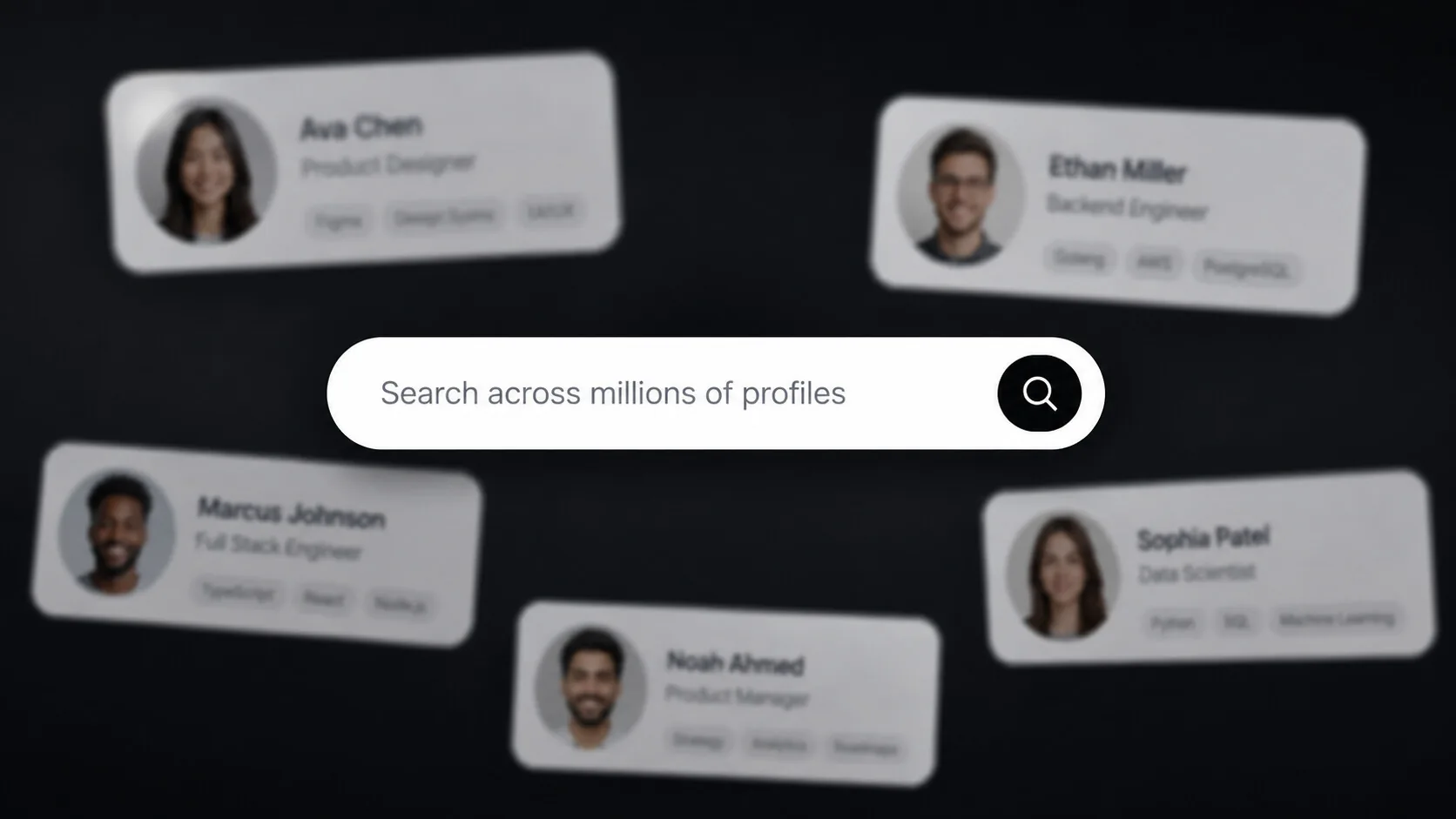
Search across millions of profiles
Ranked against a real job, kept, and reached out to, all in one place.
Global search
Describe the role. Search everyone at once.
One search, and everything that happens after it.
Plain words, not boolean. One query goes across every source you have and comes back ranked against a real job, either one of yours or any posting URL you paste in.
Finding the person is the easy half. The same place that runs the search also scores it, keeps who you passed on, and does the following up.
- Describe the role in plain words and search everyone at once
- Scored against the job, not a keyword list
- Everyone you have ever seen, still yours
- Outreach that follows up for you
Scored against the job, not a keyword list
The number always points back to why.
Everyone you have ever seen, still yours
Runners-up stay in your pool and re-rank on their own.
Outreach that follows up for you
Email, message and call, all sent from your own domain.
Every shortlisted candidate gets a screening call. Today, not next Tuesday.
SARA calls in their daytime hours and files a scored transcript before you open the record.
- Knockouts first. Visa, notice, relocation, shift, rate
- Your rubric, per job. A support hire never shares a staff engineer's curve
- Recording, transcript and score, filed before you open it
- Five retries, their daytime hours, Do Not Call honoured for good
- 01Skill assessment3:20 Walked through a real retry-logic bug she shipped a fix for.
- 02Knockout questions2:05 Cleared all four on the brief, including on-call rotation.
- 03Availability & notice1:39 On a 30-day notice; can start inside four weeks.
Then a full interview, not a coding test
Code they explain, a design board they defend, real questions on behaviour and fit. One scorecard, every number citing the line that earned it.
- Code that actually runs, and design marked on the answers, not the picture.
- Rubric scoring on skill, behaviour, reasoning, communication and fit.
- Proctored end to end, with consent. ID check is OCR only, no biometrics.
- Thin evidence lowers confidence, not the score. Nothing auto-rejects.
Add-ons
- Sourcing, screening and the AI interview come standard on every role.
- Extra rounds, checks and a system of record switch on only when a role needs them.
- Turn them off again the moment that role is filled.
You are never buying the whole suite to fill one seat.
01
Company rounds
Your own interviewers run extra rounds after the AI call.Run your own interviews after the AI round, as many as the role needs, with your interviewers and your panel. Every room opens with the AI call already read.
02
Background verification
Employment, education and identity checks on finalists.Send finalists for employment, education and identity checks from the same screen you shortlist from. Results land on the record as they clear.
03
ATS
Pipelines, stages, notes and team access, all in HiringScout.The full applicant tracking layer, with pipelines, stages, notes and team access, for when you would rather run hiring here than push candidates back out to another system.
04
Identity verification
U.S. government ID checked before the interview.A U.S. government ID is checked before the interview opens, so the person who took the round is provably the person you shortlisted.
No per-seat cost. Onboard your whole hiring ecosystem.
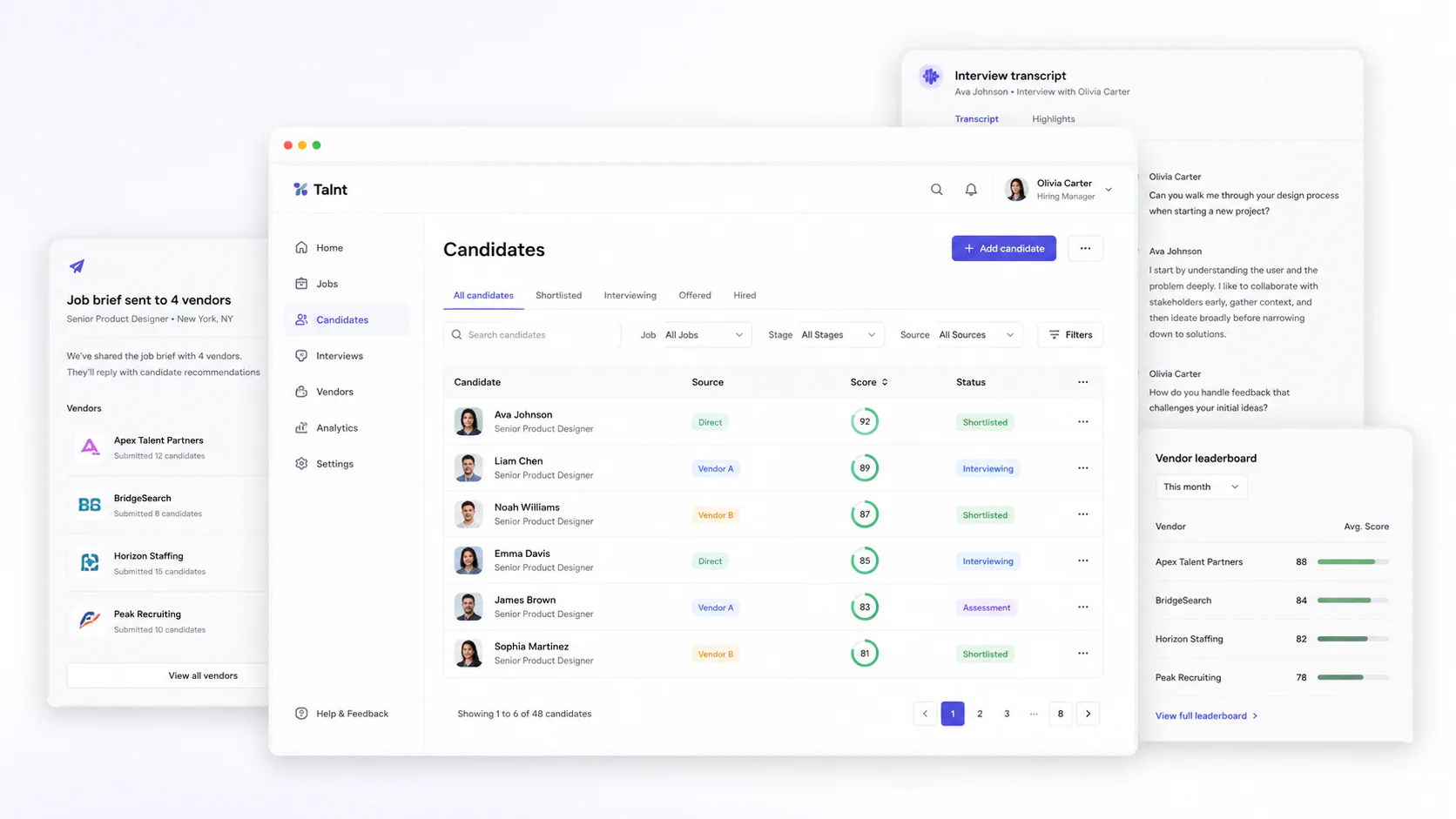
Everyone opens the same pipeline and sees exactly the slice their role covers. No exports, no stale copies, no seats to buy.
- Hiring managers see their own jobs, recruiters every job they run, admins the account, vendors only what they sent.
- Staffing? Add your customers, share a shortlist, let them run their own rounds.
- @mention a colleague and they land on the candidate; interviewers join from a link, no account needed.
- Two-factor on every account. Add anyone you like; the price doesn't change.
Your vendor partners submit on your assessment bar, not their own
No inbox, no spreadsheet. Vendor candidates run your rounds. You can finally say which vendor was worth the fee.
- Invite the vendor, not each recruiter. One brief, every vendor at once, with no head start for anyone.
- Candidates arrive scored on your rubric, with a transcript behind every number.
- Submission caps per vendor; duplicates matched on email and phone are turned away.
- Each vendor sees only its own candidates, scoped by country and pausable anytime.
Plugs into how you already work
Connect once, and posting, outreach and notifications all run through the tools your team already opens.
Greenhouse
Slack
Workable
Discord
Gmail
Outlook
LinkedIn
X
GitHub
dev.to
Facebook
Instagram
and 40+ more
Your mailbox, with outreach from your own domain
Social auto-posting on publish
Slack & Discord alerts
ATS sync
Vendor & staffing partners
What changes when screening runs in parallel
Same day
Applicants get a call or interview slot the day they apply, not after a recruiter gets to them
In parallel
Every applicant is screened at once instead of waiting in a queue for a human's calendar
Every round
A detailed assessment behind every score, not just the ones someone remembered to write up
Any hour
Calls and interviews happen in the candidate's own hours, not only during a recruiter's shift
For Job Seekers
- Practice interviews, never the real questions.
- Matched job alerts every 30 minutes.
- Public and code profiles rewritten, not scored.
- A resume fitted to each application, and every application on one timeline.
Try free
Everything a job seeker needs, in one place
01 "My clients will never accept an AI interview."
They're not being asked to. The AI round happens before your submit, because it's how you decide what to send. What reaches your client is a human recommendation with a transcript behind it, which is more than they get from you today.
A human reviews every interview outcome before it reaches your client.
02 "Can I keep my clients separate from each other?"
Each client is its own customer record with its own roles, its own context and its own candidates. A recruiter working two accounts sees two pipelines, never one merged pile, and nothing crosses between them.
Per-customer context. Scoped access per recruiter.
03 "I can't afford another tool. I'm a five-person shop."
Then count what you're replacing, not what you're adding. Sourcing, outreach, screening and the coding assessment are four line items today, and most of them charge per seat or per job. This is one price, whole team, no per-job fee.
Pay for what you use. No seats to buy, nothing to sign.
04 "How do I prove my submits are better than the next agency's?"
You send the evidence with the person. Every submit carries a transcript, a recording and a scored rubric, so the client is comparing your candidate against a record rather than against your adjectives.
Share a candidate's full record with one link.
01 "We already have an ATS. I'm not replacing it."
Don't. An ATS is a system of record. It stores what happened. This is a system of judgement; it produces the evidence your ATS then stores. They do different jobs, and yours keeps doing its one.
Works standalone, or alongside the ATS, Slack, Discord and calendar you already open.
02 "How do I know the score isn't just a guess?"
Because you can open it. Every candidate is scored against the rubric you wrote, and every number points at the moment in the transcript that earned it. If you disagree with a call, you can see exactly which answer it was reading, and say so.
Scored competencies, each traceable to a written anchor and a timestamp.
03 "What actually lands on my desk afterwards?"
A transcript, a recording, a scored rubric, and a recommendation, plus the questions the interview couldn't settle, so your human round starts where the AI stopped instead of re-asking everything.
Ready to share with your team or push straight into your ATS.
04 "How long until I'm actually running a role on this?"
About ten minutes for the first one. Paste a job description or a posting URL, check the questions it drafts, and publish. Sourcing and screening start from that, not from a configuration project.
No implementation, no onboarding call required.
01 "We staff projects, not seats. Does that fit?"
It fits better than a seat model does. Roles are opened per engagement, screened against that engagement's stack, and closed when it ships. You pay for the screening you ran, not for a headcount licence you carry between projects.
Usage-based. Roles open and close with the engagement.
02 "Can we bench-screen for skills a client hasn't asked for yet?"
Yes. Screening does not require a posted job. Run a round against a role you have not opened, keep the scored records in your pool, and re-rank the whole pool the moment a real engagement lands.
Standalone screening. Pools re-score against any new role.
03 "Our subcontractors submit people too."
Bring them in as vendors. They submit into the same pipeline on the same bar, see only their own candidates, and get scored on the people they actually send rather than on how many they sent.
Per-firm caps. Duplicates turned away automatically.
01 "Is the technical bar real, or a quiz?"
Code is actually written and run in the language the role calls for, and the design round is an actual whiteboard the candidate draws on and defends. There is no multiple choice anywhere in it.
Live execution. One recording, one transcript, one score.
02 "What stops someone having an LLM answer for them?"
The session is proctored end to end and the whole screen is shared before it opens. Every flag lands on the record with its timestamp, and nothing ends a round on its own, so you judge what it was worth.
Optional ID check ties the person to the round.
03 "Will my engineers still have to sit in first-round calls?"
No, that is the round this replaces. Your engineers join at the point where there is something to argue about, opening the room with the AI round already read and the unresolved questions listed.
Company rounds start where the AI round stopped.
04 "Does our candidate data train your models?"
No. Transcripts, recordings and scores are encrypted in transit and at rest, every action is audit-logged, and none of it trains a model. Deletion requests reach you, not a black box.
Encrypted in transit and at rest. Full audit trail.
01 "What am I actually committing to?"
Nothing on a term. You pay for what you use, there are no seats to buy, and there is no contract to sign before the first role runs. Add-ons are switched on per role and off again after it.
No seat licences. No minimum term.
02 "Which line items does this actually replace?"
Usually four. The sourcing tool, the outreach tool, the screening service and the coding-assessment vendor. Most of them bill per seat or per job today; this is one usage line for the same work.
One line item, whole team, no per-job fee.
03 "Can I see where the spend went?"
Every charge is itemised against the job and the candidate it was spent on, so a month's usage reads as a list of roles you filled rather than one opaque platform fee.
Per-role, per-candidate usage history.
01 "We have no recruiter. Can we run this ourselves?"
That is the common case. Publish the role, and sourcing, outreach, screening and scheduling run without anybody driving them. You come back to a ranked shortlist with the reasoning attached.
About ten minutes to set up a role.
02 "Who is accountable if a hire goes wrong?"
You are, and the record shows why the decision was made. Nothing auto-hires; a resume that misses your bar can be screened out automatically, but every interview outcome and every hire decision has a human on it, with a transcript underneath it.
Every hire decision has a human on it, logged.
03 "Is this going to embarrass us in front of good candidates?"
They get a slot they chose, a callback if they miss it, and a transcript they can read afterwards, which is more than most processes give them. The round carries your role and your bar, not a generic quiz.
Rescheduling and follow-up handled automatically.
01 "Is a machine deciding whether I get the job?"
Not the interview. It produces a transcript, a recording and a scored rubric. A person at the company decides your outcome from that evidence. Your resume can be screened out automatically if it clearly misses a role's stated requirements, the same way an ATS keyword filter would; every interview and every hire decision is a human call.
A human decides your interview outcome, every time.
02 "What if I can't make the time slot?"
Pick another one. You choose your own slot, you get a callback if you miss it, and rescheduling does not cost you your place in the process.
Self-serve scheduling and rescheduling.
03 "What does it cost me, and what happens to my data?"
Nothing to start. Every account includes a resume check, a practice interview and job alerts at no cost, and you only pay if you want more than that. Your record is yours either way, so you can ask for it and have it deleted, and that request reaches a person.
Free to start. Deletion on request.
Start with the role you need to fill next
About ten minutes to set up. Pay for what you use. No seats to buy, and nothing to sign.